

Women have shaped the written word for centuries, yet the role of women in literature remains one of the most contested and underexplored conversations in literary scholarship. From Sappho's lyric poetry to Toni Morrison's Nobel Prize acceptance, women have not merely participated in literary traditions. They have built them, broken them, and rebuilt them in their own image. What's rarely acknowledged is how deliberately their contributions were buried, and how much work it takes to dig them back out.
Table of Contents
- Key takeaways
- The role of women in literature across history
- Genre contributions and female characters in fiction
- Feminist literary criticism as a recovery tool
- Contemporary trends in women's publishing
- Persistent challenges for women writers
- My perspective on what this history actually demands
- Explore women's stories with Herpleasuremedia
- FAQ
Key takeaways
| Point | Details |
|---|---|
| Historical erasure is documented | Women writers were systematically excluded from canons, not because of quality, but because of gender. |
| Academic recognition is growing | By 2024, 4 of the top 10 sociology texts were women-authored, up from zero in 1998. |
| Feminist criticism recovers silenced voices | Reading texts "against the grain" exposes gendered power structures embedded in canonical works. |
| Women dominate today's market | Women authors now hold 73% of top fiction bestseller slots in 2026. |
| Community drives sustained readership | Library holds, TikTok communities, and author-hosted events build demand that outlasts traditional marketing. |
The role of women in literature across history
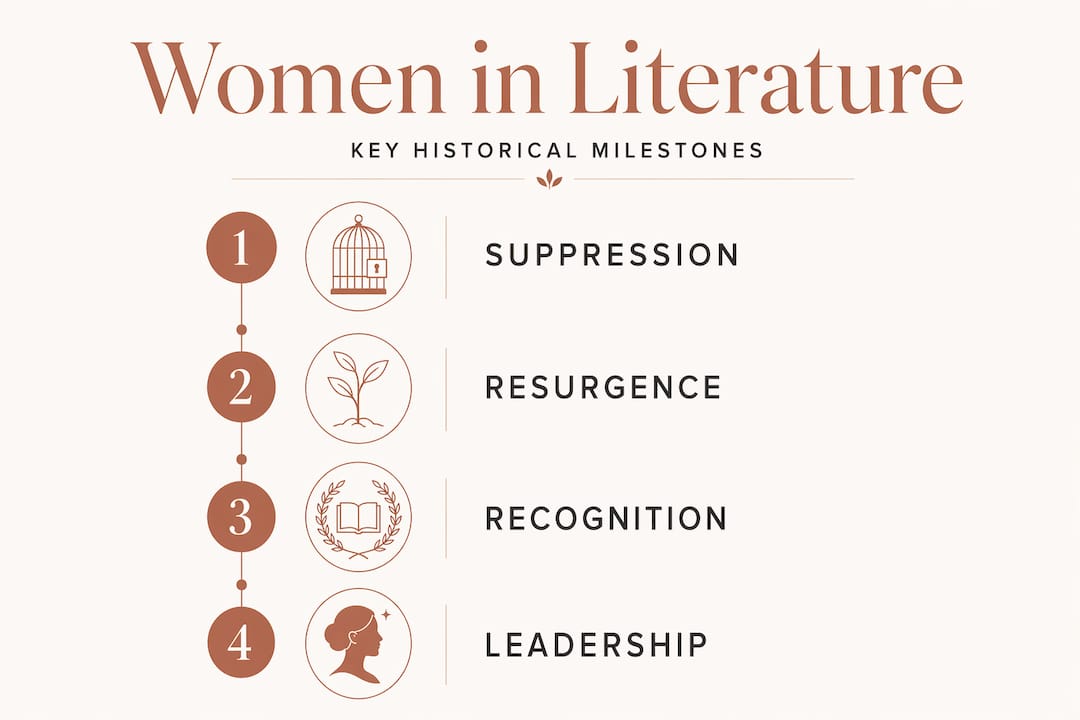
The history of women in literature is not a story of absence. It is a story of suppression followed by relentless resurgence. Women have been writing since antiquity. Sappho composed lyric poetry in ancient Greece. Murasaki Shikibu wrote what many scholars consider the world's first novel in 11th-century Japan. Christine de Pizan challenged misogynist literary traditions in medieval France. The record is long. The recognition has not kept pace.
| Era | Notable women writers | Key barrier |
|---|---|---|
| Medieval | Christine de Pizan, Hildegard of Bingen | Church and court gatekeeping |
| 18th century | Mary Wollstonecraft, Phillis Wheatley | Publishing access, racial exclusion |
| 19th century | George Eliot, the Brontës | Required male pseudonyms |
| 20th century | Zora Neale Hurston, Virginia Woolf | Critical dismissal, financial precarity |
| 21st century | Chimamanda Ngozi Adichie, Roxane Gay | Genre ghettoing, intersectional bias |
By the Victorian era, women writing under male pseudonyms was not an eccentricity. It was a survival strategy. Mary Ann Evans published as George Eliot because she knew her ideas would receive less serious treatment under her own name. That calculation was correct, and it tells you everything about the literary establishment of the time.
What makes the academic data especially striking is how recent the correction has been. Women's authorship in foundational sociological works has increased significantly, with 4 out of 10 top texts at the 2024 ESA Conference authored by women, compared to none in 1998. That shift took 26 years. It did not happen naturally. It happened because scholars, many of them women, fought for it.
Anna Beer's work on this subject makes a point that should be uncomfortable for anyone who loves literature: the systematic erasure of women writers was not incidental. It was structural. Canons were built with intention, and that intention rarely included women.
Pro Tip: When studying literary history, actively seek out syllabi and reading lists curated by feminist scholars. The texts you find there will expand your understanding of entire literary periods.
Genre contributions and female characters in fiction
Women's contributions to literature are not confined to a single shelf or category. Women authors in literature have shaped romance, speculative fiction, memoir, and literary fiction in ways that fundamentally altered what those genres could do.

Romance fiction is the most commercially powerful genre in publishing, and it has been built almost entirely by women writers and women readers. What critics often miss is that romance tropes function as intertextual tools, allowing writers to subvert gender norms through familiar narrative structures. The "forced proximity" trope, for example, is not just a plot device. In skilled hands, it becomes a mechanism for examining power, consent, and desire with more precision than most literary fiction attempts.
Speculative fiction tells a similar story. Octavia Butler, Ursula K. Le Guin, and N.K. Jemisin did not just write science fiction. They used the genre to interrogate race, gender, and power in ways that realist fiction could not contain.
The evolution of female characters in novels deserves its own examination. Two persistent patterns define the spectrum:
- The "damsel in distress" archetype: passive, defined by her relationship to male characters, rescued rather than active
- The complex female protagonist: morally gray, self-determining, whose story does not depend on romantic resolution
Research on gender stereotypes in Pakistani fiction shows that complex female leads have emerged even in traditionally conservative literary contexts, though stereotypical portrayals remain common in specific genres. This is not a regional issue. It is a global one.
The cultural significance of how female characters are written cannot be overstated. Readers, particularly young women, internalize these representations. A character who solves her own problems models something. A character who waits to be saved models something else entirely.
Feminist literary criticism as a recovery tool
Feminist literary criticism is not simply a lens for reading women's writing. It is a method for exposing what any text, written by anyone, reveals about gender and power. The distinction matters because it means feminist criticism applies to the entire literary canon, not just to books by women.
Reading "against the grain" is the core practice. It means asking whose perspective structures the narrative, whose desires drive the plot, and whose interiority the text treats as worth exploring. Most canonical texts, when read this way, reveal assumptions so embedded that they become invisible without deliberate analysis.
"Feminist literary criticism functions as a necessary tool to analyze gender and power, reading against the grain of canonical texts to expose ideological mechanisms that condition representation." The Feminist Literary Criticism Approach
The concept of "reward-dualism" explains a specific mechanism of canon formation. Women's works are confined to gender-specific categories even when their literary achievement equals or exceeds that of male contemporaries. A novel about domestic life written by a woman gets labeled "women's fiction." A novel about domestic life written by a man gets labeled "literary fiction." The content can be nearly identical. The categorization determines the cultural weight assigned to it.
Linguistic analysis adds another layer. Reporting verbs and narrative voice subtly reinforce gender stereotypes even in texts that consider themselves progressive. A female character who "whispers" her opinion while a male character "declares" his is not a neutral stylistic choice. It is ideology embedded in grammar.
Pro Tip: When doing feminist literary analysis, pay close attention to the verbs used to describe how characters speak and act. Those micro-level choices often reveal more about a text's gender politics than its plot does.
Contemporary trends in women's publishing
The contemporary picture of women's contributions to literature looks dramatically different from any previous era, and the data makes that clear.
In 2026, women authors hold 73% of top fiction bestseller slots with increased representation across thriller, literary fiction, and nonfiction. This is not a niche phenomenon. It is a structural market shift.
What is driving it? The answer is community. Traditional publishing marketing has always favored authors with existing platforms. What changed is that readers built their own infrastructure for discovery and recommendation.
- Library holds rose 41% for women-authored debuts, with 78% purchase conversions following borrowing.
- TikTok's BookTok communities surface women's fiction in formats that match how younger readers consume content, short clips, emotional hooks, and community reactions.
- Author-hosted events including annotated editions, community swaps, and discussion series build sustained reader engagement that outlasts any single press cycle.
- Intersectional genre hybrids have replaced the limiting "women's fiction" label, with books now marketed as psychological thrillers, speculative memoirs, and cultural fiction.
The literary canon as cultural engineering concept helps explain why this market success matters beyond sales figures. When women-authored books dominate bestseller lists and generate sustained community engagement, they are building a new kind of canon. One that does not require institutional gatekeeping to validate it.
Contemporary authors like Colson Whitehead, Yaa Gyasi, and Brit Bennett are reshaping what American literary fiction looks like. Women authors are not waiting for academic recognition to catch up. They are building their audiences directly.
Persistent challenges for women writers
Progress is real. So are the structural problems that remain. Understanding both is necessary for anyone serious about women's voices in storytelling.
The challenges women writers face in 2026 are not the same as those in 1926, but they share a common architecture:
- Genre ghettoing continues to devalue women's writing even when it is structurally sophisticated. A woman writing a thriller is still more likely to be shelved with "domestic suspense" than with crime fiction written by men.
- Intersectional invisibility compounds the problem for Black women writers, Indigenous writers, and other multiply marginalized authors. Their work is often celebrated within specific communities while remaining invisible in mainstream critical discourse.
- Media representation presents its own contradictions. Female protagonists like Ellie from The Last of Us II demonstrate genuine narrative depth, yet coexist in the same industry with overtly sexualized side characters. Inclusion without structural redesign is not equity.
- Publishing gatekeeping still favors certain kinds of stories. Narratives about Black women's interiority, desire, and liberation remain underrepresented in major publishing catalogs relative to their cultural significance.
The gap between market success and critical recognition remains real. Women authors dominate bestseller lists and build devoted readerships, yet awards, academic syllabi, and critical essays still skew toward male authors in many contexts.
My perspective on what this history actually demands
I've spent years reading, analyzing, and writing about women's literary contributions, and the thing that strikes me most is not the erasure. It's the persistence. Women kept writing through every era that told them not to. They published under pseudonyms, circulated manuscripts privately, and built literary networks that existed entirely outside official channels.
What I've learned from that history is that recognition was never the primary motivation. The writing was. And that changes how I think about the current moment.
We are living through a genuine shift in women's literary power. The bestseller data, the community engagement numbers, the academic canon revisions. These are real. But I am cautious about declaring victory, because the structural biases that shaped the last several centuries do not dissolve in a decade.
What I've found actually matters is not just celebrating women writers, but changing how we read. Feminist literary analysis is not a political imposition on literature. It is a more complete way of understanding what texts do and how they do it. Every reader who learns to ask whose perspective is centered and whose is erased becomes a better reader. Full stop.
The work Herpleasuremedia does in centering Black women's stories is not supplementary to the literary conversation. It is the literary conversation that mainstream institutions have consistently failed to have. That matters more than any bestseller list.
— Tiana Hercules
Explore women's stories with Herpleasuremedia
If this history has you thinking about whose stories you've been reading and whose you've been missing, that's exactly the right question to sit with.
Herpleasuremedia is a platform built specifically to center the stories, voices, and perspectives of Black women across literature, audio, film, and live events. The conversations happening here go beyond what any single article can hold. From discussions of bodily autonomy and sexual freedom to generational healing and cultural liberation, the work is ongoing and the community is active. If you want to go deeper into reflective engagement with women's literary and cultural contributions, the daily reflection space is a place to start. Come for the writing. Stay for the conversation.
FAQ
What is the role of women in literature historically?
Women have been writers, critics, and cultural architects since antiquity, though their contributions were systematically excluded from official canons. The recovery of their work is an ongoing scholarly project that has accelerated significantly since the late 20th century.
How has feminist literary criticism changed how we read?
Feminist literary criticism introduced the practice of reading texts to expose gendered power structures, asking whose perspective is centered and whose is erased. It applies to all literature, not just texts written by women.
Why do female characters in novels still reflect stereotypes?
Research shows that stereotypical female portrayals persist because genre conventions and market expectations often reward familiar archetypes. Complex female protagonists are growing in number but still coexist with passive or sexualized representations across media.
What genres have women authors most significantly shaped?
Women authors have been foundational in romance, speculative fiction, memoir, and literary fiction. Romance in particular is built almost entirely on women's creative and economic participation, and its narrative structures carry more literary sophistication than critics typically acknowledge.
How are women's books performing in today's publishing market?
In 2026, women authors dominate fiction bestsellers with 73% of top slots, driven by community reading practices including library holds, BookTok, and author-hosted engagement events that sustain readership beyond traditional marketing cycles.